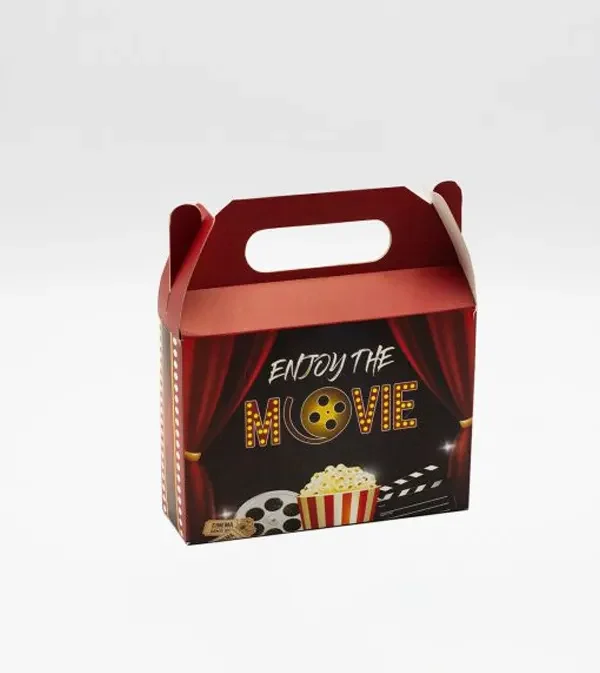
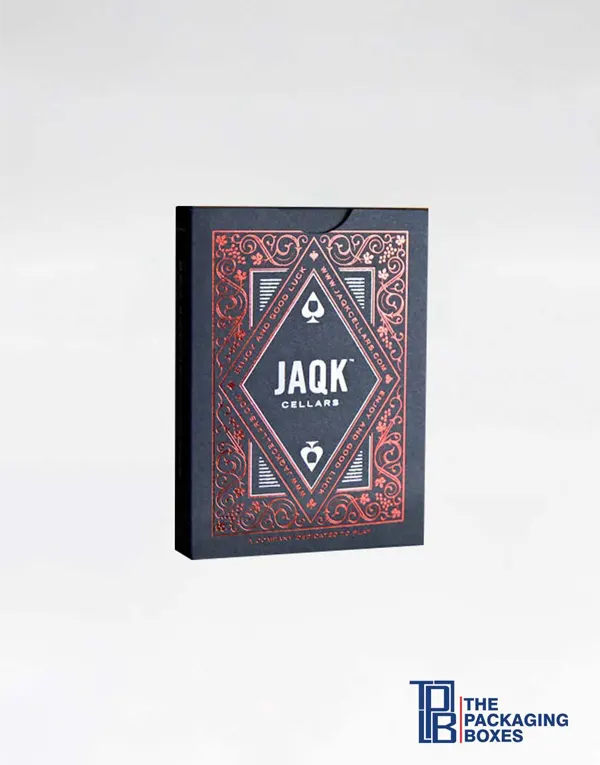
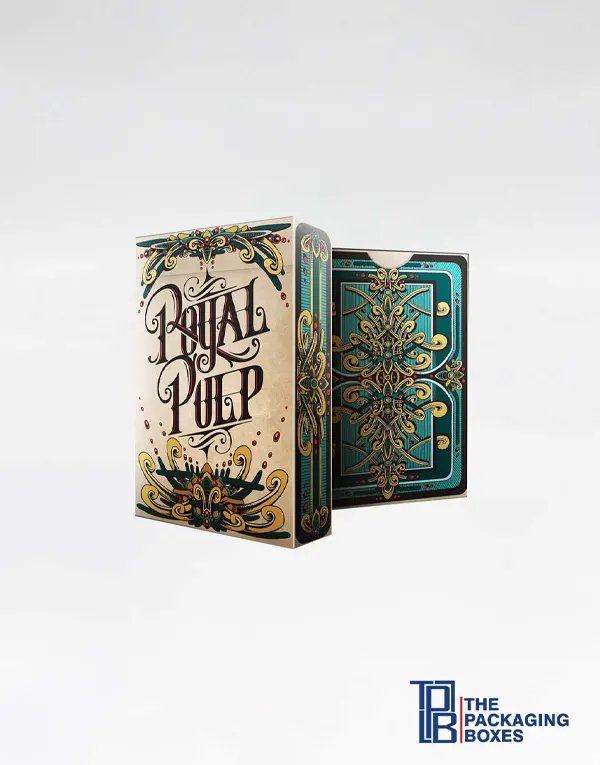
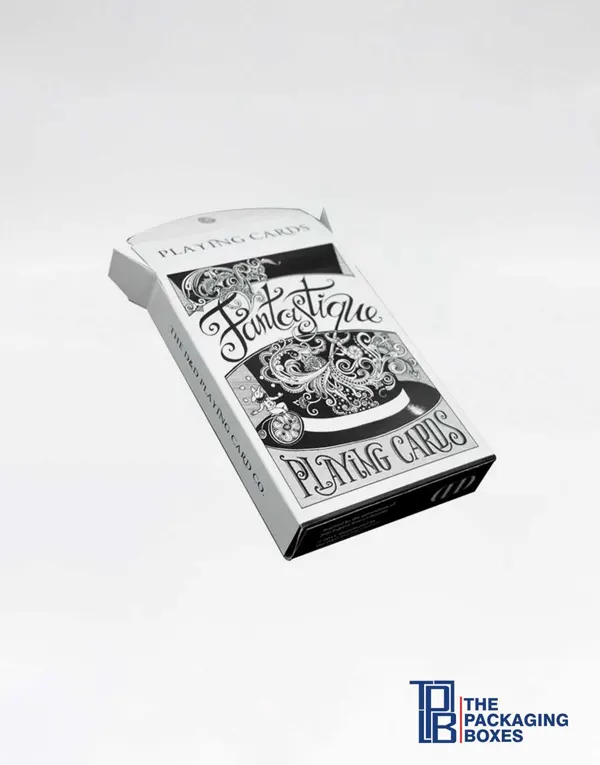
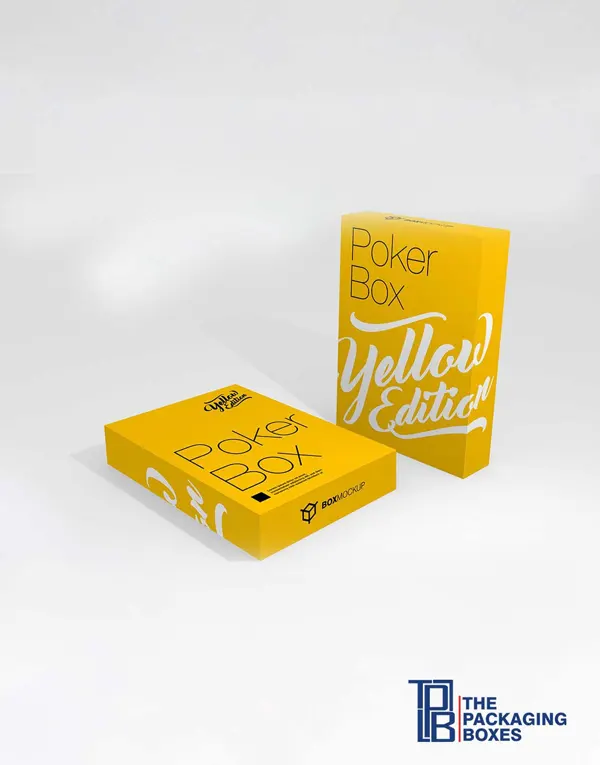
A deck of cards is judged by its box before a single card is dealt. Playing card boxes, usually called tuck cases, are snug paperboard cartons sized to the thickness of a deck. Game designers, magicians, casinos and promotional companies buy playing card boxes from Boxify Now in poker, bridge, tarot and custom sizes. Our custom printed playing card boxes can carry foil, embossing and inside printing. We supply playing card boxes wholesale for large runs and playing card boxes with logo artwork for corporate gifts at low minimums. Buy now or request a quote.
Playing card boxes are small cartons made to hold a deck of cards snugly, protect its edges and identify the deck at a glance. The most common form is the tuck case, a paperboard box with a flap that tucks into the top, though rigid and specialty versions are used for premium decks.
Playing card boxes are sized to the card format they hold, and three formats cover most orders. Poker-size cards measure 2.5 x 3.5 inches. Bridge-size cards are slightly narrower at 2.25 x 3.5 inches. Tarot cards are commonly 2.75 x 4.75 inches, though tarot and oracle decks vary widely from one publisher to another.
Poker size is the default for most custom decks, and for magic and cardistry, because the wider card shows artwork well. Bridge size is easier to hold when a player has many cards in hand, which is why it is common for bridge and other trick-taking games.
The box interior is a touch larger than the card in length and width so the deck slides out without catching. Flash cards, trading card sets, mini decks and oversized novelty decks all need custom dimensions, which we draw to your card size.
The depth of the box depends on two things: how many cards are in the deck and how thick each card is. A standard 54-card deck on typical card stock stacks to roughly five-eighths of an inch, but a 78-card tarot deck or a 100-card game deck is far thicker, and linen-finish or heavy stocks add more.
The most reliable method is to measure a finished deck, squared up and lightly pressed, with calipers or a ruler. If the cards are not printed yet, tell us the card count and the stock your card printer is using and we will calculate it. A box that is too deep lets the deck rattle and wear at the corners; one that is too tight splits at the side seam. If the deck will be wrapped in a paper band or include a folded rules sheet, include that in the measurement.
The standard for a reason: it is compact, inexpensive and opens with one thumb. Our tuck boxes page covers straight and reverse tuck layouts. For cards, a top tuck with a glued bottom is common, since the deck only ever leaves from one end.
A lid and base made from wrapped chipboard gives a deck real weight and protects it for years. This is the usual choice for tarot decks with guidebooks, luxury editions and gift sets.
A printed sleeve over a plain tuck case adds a layer for limited editions. Hinged-lid boxes with magnetic closures hold two or more decks with dividers. Publishers who need a larger box for cards plus boards and tokens should look at our custom game boxes.
Collectors and magicians handle a lot of decks, and small touches separate an ordinary case from a memorable one.
A thumb notch, the half-moon cut at the top of the front panel, makes the flap easier to lift. A seal label across the flap shows the deck is unopened and is a good place for an edition number. Inside printing turns the interior into part of the design, often with a pattern, a hidden message or a reveal used in a magic routine. Embossing on the back design or logo gives a tactile cue, and foil stamping catches light on borders and lettering.
Finish affects handling too. Matte and soft-touch laminations feel smooth and resist fingerprints. Gloss is bright and durable. A light aqueous coating gives a plainer, vintage feel that suits heritage-style decks.
Most retail decks are closed with a seal label and then wrapped in clear film to keep the case clean on the shelf. If your card printer or fulfillment house is overwrapping the decks, give them the finished outside dimensions of the tuck case, and keep the barcode on a flat panel so it scans through the film.
Custom playing card boxes are ordered by a wider group than most people expect:
Retailers selling decks at the counter often request a matching printed tray, and our display boxes can be sized to hold a dozen tuck cases upright.
A tuck case has a front, a back, two sides, a top flap, a bottom and glue tabs, all printed on one flat sheet. Work on the dieline we supply and keep a few points in mind. Some panels sit upside down relative to the front on the flat layout, so check orientation on the 3D mockup. Keep borders generous, since a thin border exaggerates any slight shift in cutting. Leave the glue tab free of ink and coating so the adhesive bonds. Place the barcode on the bottom or back panel. Files should be PDF, AI or EPS at 300 DPI in CMYK, with PMS colors called out if you are using them.
We make playing card boxes to the exact size of your deck, with no die or plate charges and free design support for creators who have card art but no packaging experience. Custom inserts and dividers are available for multi-deck and gift sets. You see a digital proof and a 3D mockup before production. Low minimums suit a short promotional run or a first edition, and shipping is free; your quote will confirm delivery details for your location.
Send us the card size, card count and stock, the box style and the quantity. We will reply with a quote that confirms the timeline, then prepare your dieline and proof. Request a quote for custom playing card boxes and give your deck the case it deserves.
A standard poker deck uses cards of 2.5 x 3.5 inches, and the tuck case is made slightly larger with a depth of about five-eighths of an inch for 54 cards. We confirm exact internal dimensions from your card stock.
A tuck case is the familiar paperboard box a deck of cards comes in. It has a top flap that tucks inside the front panel, and often a thumb notch for easy opening. It ships flat and is filled by hand or machine.
Yes. Tarot and oracle decks vary in card size and count, so each box is made to measure. Many artists choose a two-piece rigid box with room for a guidebook, while others prefer a deep tuck case.
Measure a finished deck squared up and lightly pressed. If the cards are not printed yet, send the card count and the stock thickness from your card printer, and we will calculate the depth and include a small allowance for easy removal.
Tuck cases are generally made from SBS paperboard, which folds cleanly and prints sharp detail. Heavier calipers are used for large decks. Collector and gift editions often use rigid chipboard wrapped in printed paper.
Yes. Inside printing in CMYK or PMS is available. Designers use it for patterns, signatures, edition details or a reveal that works with a magic effect. Let us know at the quote stage so it is included on the dieline.
The flap can be designed to take a seal label, and the seal can be produced as a printed sticker to match the deck. Seals show that a deck is unopened and can carry a logo or an edition number.
A thumb notch can be added to the front panel on request. It is standard on most poker-size tuck cases because it makes the flap easier to lift, though some designers leave it off for a cleaner, uninterrupted front.
Yes. Multi-deck boxes can be made as wider tuck cases, two-piece boxes or hinged rigid boxes with a divider between decks. Tell us how many decks and whether each will sit in its own tuck case inside.
Paperboard tuck cases ship flat with the side seam glued, ready to pop open and fill. Rigid two-piece and hinged boxes arrive assembled. Flat delivery keeps storage and handling simple for card printers and fulfillment teams.
Send PMS references or a printed card and we will match as closely as the process allows. PMS spot inks give the most consistent results for solid brand colors, while CMYK suits detailed illustrations and photographs.
Yes. Low minimums make it realistic to box a first edition, a prototype run or a corporate gift deck. Share the quantity with your quote request and we will confirm what is available for your size and finish.
Matte and soft-touch lamination give a smooth, premium hand feel. Gloss is bright and hard-wearing. Foil stamping, embossing, debossing and spot UV are widely used on borders, logos and titles to add detail collectors appreciate.
Yes. A digital proof and a 3D mockup are sent before production. Because some tuck case panels print upside down on the flat sheet, the mockup is the easiest way to confirm every panel reads correctly when folded.
The production timeline is confirmed on your quote and depends on quantity, style and finishing. Shipping is free, and your quote will also confirm delivery details for your location. Tell us if you have a launch or convention date to meet.