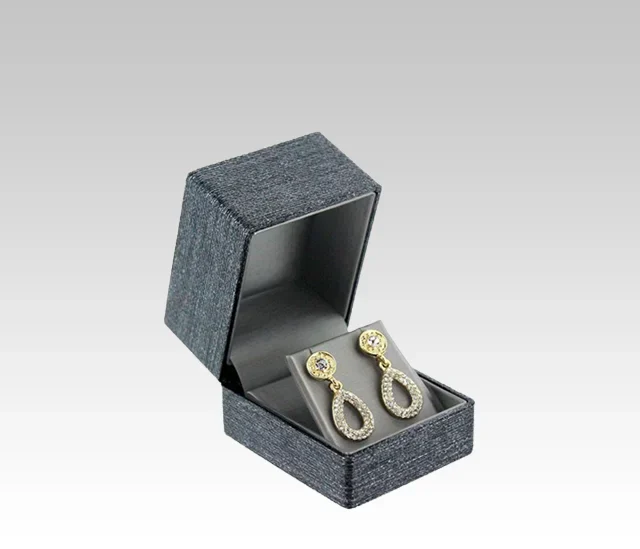
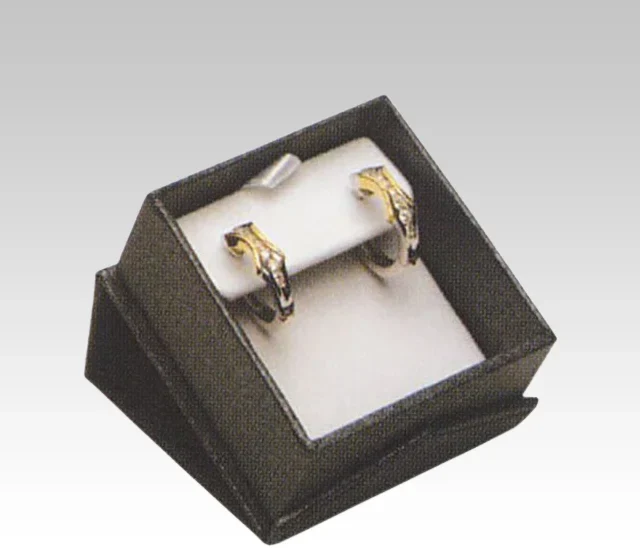


From tiny studs to long drops, every pair of earrings needs a box that keeps both pieces together and facing forward. Earring boxes from Boxify Now are made in rigid board, paperboard and kraft, with foam pads or punched cards sized to your designs. Jewelry makers, boutiques and piercing studios buy earring boxes for gifting, shipping and counter display. Choose custom printed earring boxes with your logo in foil on the lid. Earring boxes wholesale orders include free design support, a digital proof and low minimums. Buy now or request a quote.
Earring boxes are small jewelry boxes fitted with a pad or card that holds a pair of earrings in position, side by side, so they do not tangle, scratch or separate. They are used to display earrings in stores, to present them as gifts and to protect them in the mail. Depending on the price of the jewelry, they are made from wrapped rigid board, folding paperboard or kraft.
Earrings vary more in shape than any other jewelry, and one insert does not fit them all. Start with what you sell.
Studs are the easiest to box. The posts push through two pinholes or short slits in a foam pad or card, and the backs go on behind to lock them. A compact square box is enough. The only real requirement is depth below the pad, because a post with its back fitted needs somewhere to go.
Hoops have no flat back to sit against a pad. Small huggies can be closed through a pair of holes. Larger hoops are better laid flat on a soft fiber fill or hooked over notches at the top of a card so they hang freely. Size the box to the outer diameter of the hoop with a little margin.
Long earrings need height. Ear wires and lever-backs hook through a hole or slot near the top of a tall card, and the drop hangs below it. Leave clearance at the bottom so the lowest bead or tassel does not rest on the base and bend. Heavy statement pairs benefit from a second slit or a soft band lower down to stop them swinging.
Clip-ons grip the top edge of a card or a raised bar, so mention them if they are part of your range.
An earring card is a flat printed card that carries the pair on its own. A box insert is a pad or platform fixed inside a box. Many brands use both together.
The card does the selling. It shows the logo, the metal, the price and sometimes a short story about the maker, and it can hang on a display rack. Slipped into a box, it becomes the insert, which means you can change designs without changing the box. Use heavy card stock for this. Thin card tears at the holes after a few pairs have been pushed through it.
A fixed foam or flocked pad feels more luxurious and suits fine jewelry, where the box is opened once at the counter and again when the gift is given.
As small as the pair allows, but not smaller than the post requires. For studs, a box around two inches square is typical. The inside depth should be close to an inch so the posts and backs sit below the pad without pressing against the base.
For hoops, measure the outer diameter and add about a quarter inch all around. For drops, measure from the top of the ear wire to the lowest point of the earring, then add space at both ends. Measure the width of the pair as they will sit, not one earring doubled, because wide designs need a gap between them.
If your range runs from studs to long drops, two box sizes usually cover it: a small square and a taller rectangle. Send us the dimensions of your smallest and largest pair and we will suggest where to draw the line.
Choose rigid board for fine jewelry and gifts, and paperboard or kraft for volume and everyday pieces.
Rigid chipboard wrapped in paper keeps its shape in a handbag or a parcel and feels substantial for its size. SBS paperboard gives a smooth white surface for bright, detailed printing and ships flat, which keeps storage and freight down for sellers who move hundreds of pairs. Kraft has a natural brown surface that suits handmade, beaded and polymer clay earrings, and it looks good with a single dark ink.
Paper-based packaging is widely recyclable, though local rules vary. Foam pads and window film should be separated where your local program asks for it.
Earrings sold online face two risks: the box is crushed, or the pair works loose inside it. A rigid or sturdy drawer box handles the first. For the second, make sure the backs are fitted behind the pad, and close the box with a snug lid or a seal so it cannot open in transit.
Do not send a paperboard earring box loose in a thin envelope. Place it in a padded or rigid outer. Many small sellers use printed paper mailer bags with a layer of tissue around the box, which protects it and gives the parcel a branded look from the outside.
Printed earring boxes are small, so restraint works. A logo on the lid in foil stamping, embossing or debossing is often all the outside needs, on a matte or soft-touch background. CMYK and PMS printing are available outside and inside if you want a pattern or a full color wrap, and spot UV can pick out a detail.
The inside of the lid is useful space. Use it for a care note, the metal type or your social handle. Customers read it every time they open the box.
Earrings are often sold with something else. A pendant and stud set, or a bridal trio, looks more valuable when the packaging matches. Order custom earring boxes in the same wrap, color and foil as your necklace boxes and ring boxes, and a gift set comes together without extra design work.
To order, send your earring measurements, the box style, the quantity and your artwork as a PDF, AI or EPS file. Your quote confirms the price and the timeline.
Buy earring boxes that hold the pair properly and show your name well. Order now, or request a quote and tell us what you make.
A box about two inches square suits most studs. Depth matters more than width. Allow close to an inch inside so the posts and their backs fit beneath the pad. Send the size of your largest stud and we will confirm the dimensions.
Hoops need a square box a little wider than their outer diameter. Drops need a taller rectangular box, measured from the top of the ear wire to the lowest point with clearance at each end. Custom sizing means the box fits your designs.
Yes. Inserts are made to suit the earring type: foam or flocked pads with slits or pinholes for posts, punched cards for ear wires, or soft fiber fill for hoops. Tell us what styles you sell so the insert is specified correctly.
A card is a flat printed piece that holds the pair for display. A box encloses and protects them. Many sellers mount earrings on a card and place the card in a box, which lets one box size work for many designs.
Yes. Ear wires and lever-backs hook through a hole or slot near the top of a tall card or pad, and the earring hangs below. For heavier pairs, a second slit lower down keeps them from swinging against each other in transit.
On the posts, behind the pad or card. Fitting the backs locks the studs in place and keeps the set complete for the customer. The box needs enough depth beneath the insert for this, which we allow for when sizing.
Yes. A larger pad or card can be punched for two, three or more pairs, which suits stud multipacks and gift sets. A divided insert can also hold earrings with a pendant or ring. Send the layout you have in mind.
Rigid board suits fine jewelry and gifts because it keeps its shape. SBS paperboard is economical, prints brightly and ships flat. Kraft suits handmade ranges. The right choice depends on your price point and how the boxes will be shipped and displayed.
Logos can be printed in CMYK or PMS, or applied by foil stamping, embossing or debossing. On a small lid, a single foil or debossed mark usually looks best. The inner lid can also be printed with a care note or brand message.
Rigid and drawer-style boxes cope well inside a padded or rigid outer. Paperboard boxes need more protection and should not travel loose in a thin envelope. Fit the earring backs and seal the lid so the pair stays on the insert.
Minimums are low, which suits makers launching a first collection as well as established stores. The options available depend on the box style and insert. Your quote lists them and shows how the unit price changes at higher quantities.
It varies with the box construction, the insert and any foil or embossing. Folding boxes are generally quicker to produce than wrapped rigid boxes. The timeline for your order is confirmed on your quote, so mention any market date or holiday deadline.
Yes. A digital proof and 3D mockup show your artwork, the logo size and the box structure. You check and approve it before production starts. Revisions at this stage are included in our free design support.
PDF, AI or EPS files at 300 DPI in CMYK. Vector logos give the sharpest results for foil and embossing on small lids. If you need help adapting a logo to a small format, our design team will assist free of charge.
Shipping is free, and your quote will confirm delivery details for your location. Paperboard and kraft folding boxes ship flat where the style allows. Rigid boxes arrive assembled with pads fitted, so they are ready to use straight from the carton.