
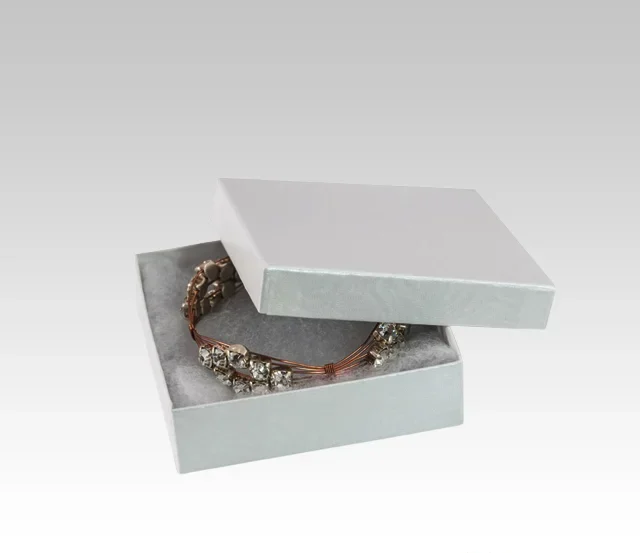


Bangles are rigid and easily scratched, so they need a box built around their diameter. Bangle boxes from Boxify Now hold a single bangle, an open cuff or a stacked bridal set on a pillow, roll or slotted insert. Jewelers, boutiques and online sellers buy bangle boxes in wrapped rigid board or printed paperboard. Choose custom printed bangle boxes with your logo in foil on the lid and a lining that flatters gold or silver. Bangle boxes wholesale orders include free design support, a digital proof and low minimums. Buy now or request a quote.
Bangle boxes are jewelry boxes shaped and fitted to hold rigid bracelets: closed bangles, open cuffs and stacked sets. They have a square, round or long cavity sized to the bangle’s diameter and an insert that fills the center of the ring so it cannot slide or knock against the walls. Jewelers, boutiques, bridal stores and online sellers use them for display, gifting and safe delivery.
Because a bangle does not bend. A chain bracelet lies flat in a long, narrow box. A bangle keeps its circle, so it needs a cavity as wide as its outer diameter in both directions and something to hold it in the middle.
Without that support the bangle rattles. Polished gold and silver pick up fine scratches from the box walls, enamel chips at the edges, and glass or lac bangles can crack outright. A proper bangle box solves this with fit, not padding alone: the insert grips the inside of the ring, and the walls sit just clear of the outside.
The answer depends on how many pieces go in the box and whether the bangle is a closed circle.
A square box a little wider than the bangle is the standard choice. The bangle lies flat around a cushion or sits in a slotted pad. A slightly deeper box takes two or three bangles stacked on the same cushion.
Cuffs and hinged bracelets are often oval, not round, and a cuff has a gap. They sit best on a C-shaped holder or a pad with a curved slot that follows the oval. Measure both the long and short axis so the cavity is not cut as a circle.
Sets of a dozen or more are stored upright on a bangle roll, a padded bar that passes through the whole stack. A long box holds one roll. Wider boxes hold two, three or four rolls side by side for full bridal sets, and many stores present them alongside other wedding boxes in matching colors.
Size the box from the outer diameter of the bangle, not the size printed on its tag. Traditional bangle sizes describe the inner diameter, which is the part that passes over the hand:
The outer diameter is larger by twice the thickness of the metal, and a chunky bangle can add half an inch or more. Measure straight across the outside at the widest point.
Then measure the width of the band. For a bangle lying flat, the box depth is the band width plus the pad beneath it and a little headroom. For a set on a roll, multiply the band width by the number of bangles to get the stack length, and allow for the fact that the box must be deep enough for the full diameter standing on edge.
If you sell several sizes, one box built for your largest bangle usually works for all of them when the insert is soft enough to take up the difference.
Whichever you choose, the covering matters as much as the shape. A soft, lint-free surface is kinder to high-polish metal than bare foam.
Rigid chipboard wrapped in paper is the usual choice for gold, silver and stone-set bangles. It has the weight customers expect with fine jewelry and it protects the piece in a handbag or a drawer. Lift-off lids and hinged lids are both common.
Printed paperboard suits fashion, glass and costume bangles sold in volume. These boxes ship flat, fold up at the counter and cost less per piece. Kraft board works well for wood, resin and handmade pieces.
Round boxes are worth considering too. A cylinder echoes the shape of the bangle and stands out on a shelf of squares, and rigid round boxes can be fitted with a central cushion or roll.
Add a window when shoppers need to see color and quantity without opening the box. Multi-color glass sets and festive assortments sell on sight, so a die-cut opening covered with clear PET film helps them move. Our window boxes use the same construction in other shapes.
For fine jewelry, a solid lid is usually better. It keeps light and dust off the metal, and it saves the reveal for the moment the customer opens it.
Printed bangle boxes can carry CMYK or PMS color on the outside and inside. Most jewelers keep the exterior simple, a solid color with the store name foil stamped, embossed or debossed on the lid, and let the lining do the work.
Lining color changes how the jewelry looks. Black and deep navy make yellow gold and diamonds glow. Ivory and pale gray suit silver, pearls and colored stones. Red and maroon are traditional for bridal sets. Matte or soft-touch lamination on the outside resists fingerprints, and spot UV can pick out a pattern or monogram.
Boxify Now makes custom bangle boxes to your measurements, with inserts and dividers cut for the pieces you sell. Design support is free, there are no die or plate charges, and you see a digital proof and a 3D mockup before anything is produced. Minimums are low, which suits independent jewelers and seasonal collections. Many stores order bangle packaging as part of a coordinated range of custom jewelry boxes so every purchase leaves in the same colors.
To order, send the outer diameter and band width of your bangles, the number per box, the box style and your artwork as a PDF, AI or EPS file. Shipping is free, and your quote will confirm delivery details for your location and the timeline.
Buy bangle boxes that fit the jewelry instead of merely containing it. Order now, or request a quote and tell us about the pieces you need to pack.
The box cavity should be slightly wider than the bangle’s outer diameter. For most adult bangles that means a square interior of roughly three and a half to four inches. Chunky designs need more. Send us your largest piece’s measurements and we will size from that.
Measure straight across the outside at the widest point, then measure the band width. For oval cuffs, take both the long and short axis. Bangle sizes such as 2-6 refer to the inner diameter, so they are not enough on their own.
Yes. Long boxes with a padded roll hold a stack of a dozen or more, and wider boxes take several rolls for bridal sets. Tell us the band width and the count per stack so the roll length and box depth are correct.
It is a padded cylindrical bar that slides through a stack of bangles and rests in notches at each end of the box. It keeps the set in order, stops pieces knocking together and lifts out in one piece for display or storage.
A cuff needs its own insert. Cuffs are usually oval and have a gap, so a C-shaped holder or a pad with a curved slot holds them better than a round cushion. Give us the long axis, short axis and band width.
Use an insert that stops all movement. A roll for stacks, or a snug cushion for single pieces, keeps bangles from striking each other or the box wall. Soft, covered surfaces are safer for enamel edges than hard card or uncovered foam.
Fine jewelry boxes are typically rigid chipboard wrapped in printed or textured paper. Fashion and costume bangles are often packed in SBS paperboard or kraft folding boxes with a card insert. We suggest a material based on the value and weight of the piece.
Yes. A die-cut window covered with clear PET film lets customers see the colors and count without opening the box. It works well for multi-color sets in retail. For gold and stone-set pieces, most jewelers prefer a solid lid.
Dark linings such as black or navy flatter yellow gold and diamonds. Ivory, cream and pale gray suit silver and colored stones. Red and maroon are popular for bridal sets. The lining and insert covering can be matched to your brand colors.
Yes. Logos can be printed in CMYK or PMS, or applied with foil stamping, embossing or debossing. The inner lid can be printed too. Vector artwork gives the cleanest foil edges, and our design team will help prepare the file at no charge.
Minimums are low, so independent jewelers and small collections are welcome. The quantities offered depend on the box construction and the insert type. Your quote lists the options and shows how the unit cost changes as the order size increases.
The schedule depends on the structure, the insert and the finishes. Rigid boxes with covered inserts take longer than folding boxes. The timeline is confirmed on your quote, so mention wedding-season or festival deadlines when you first contact us.
Yes. A digital proof and 3D mockup show the artwork, the logo position and the box structure. You approve it before production begins. Changes requested at the proof stage are handled under our free design support.
Send a PDF, AI or EPS file at 300 DPI in CMYK. For foil, embossing and debossing, a vector logo is best. If you have only a low-resolution image, our design team can help prepare it for print.
Shipping is free, and your quote will confirm delivery details for your location. Paperboard bangle boxes ship flat where the style allows and fold up when needed. Rigid boxes arrive assembled, with their cushions, rolls or pads supplied to fit.


