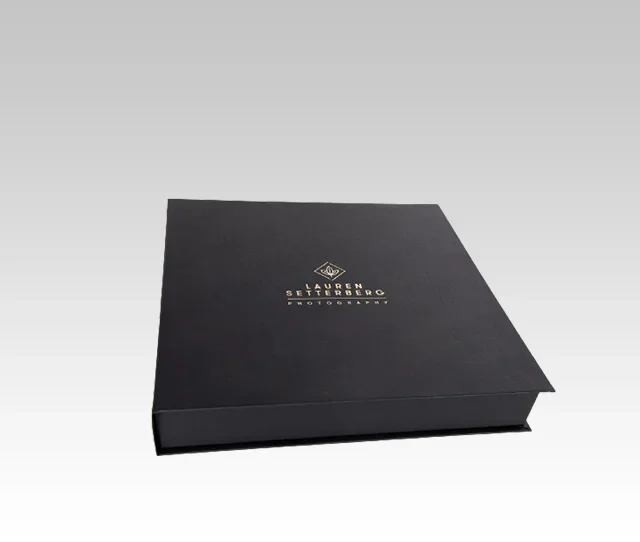
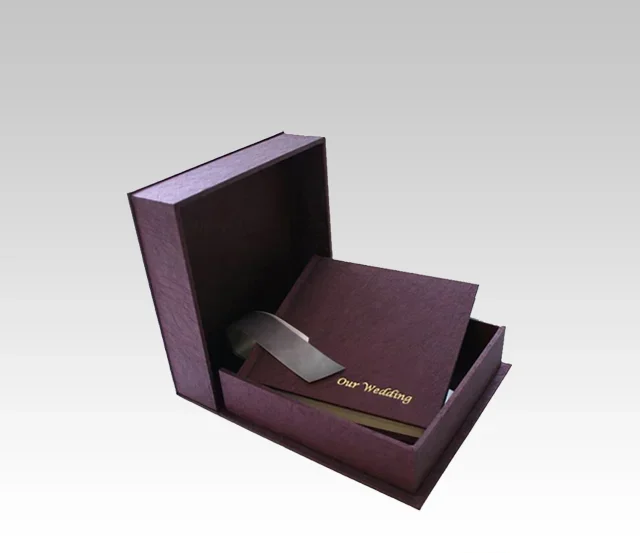
Album boxes protect wedding albums, photo books and vinyl records, and they give the handover to a client the weight it deserves. Photographers, studios and print labs buy album boxes from Boxify Now in rigid board or paperboard, sized to the exact cover and spine. Order custom printed album boxes with linen-look wraps, a ribbon lift or a USB well. Album boxes wholesale orders include free design support, a digital proof and low minimums, and every lid can be finished with your logo. Buy now or request a quote.
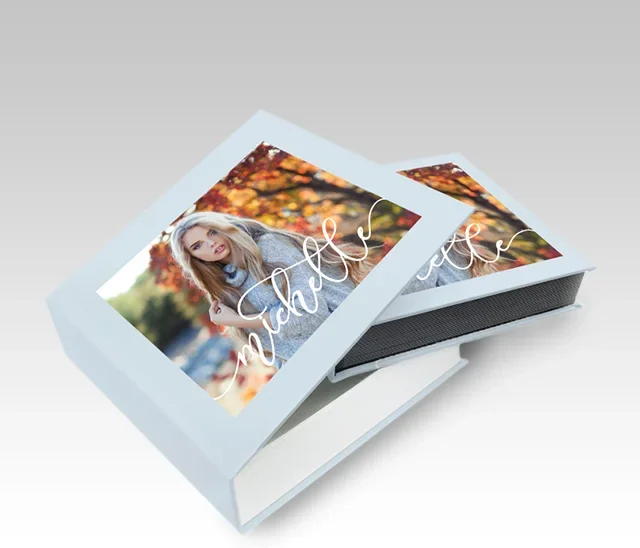
Album boxes are presentation and storage boxes built to the dimensions of a photo album, photo book or record, usually from rigid board wrapped in printed paper or a textured cover material. They keep covers and corners safe from dust, light and knocks, and they turn the delivery of a finished album into a proper handover. Photographers, studios, print labs and record labels use them for client deliveries, retail sales and long-term storage.
Most orders come from businesses that sell or hand over a finished album and want the packaging to match the work inside.
Measure the finished, closed album rather than the page size, because covers overhang the pages and thick spreads make the book deeper than you expect.
Send us those figures and we work out the internal box dimensions. A bare album usually needs about an eighth of an inch of clearance on each side so it lifts out without scraping. An album in a cloth bag or wrapped in tissue needs a little more. If you offer the same album in several thicknesses, tell us the range, since one box depth with a foam or card spacer can sometimes cover two page counts.
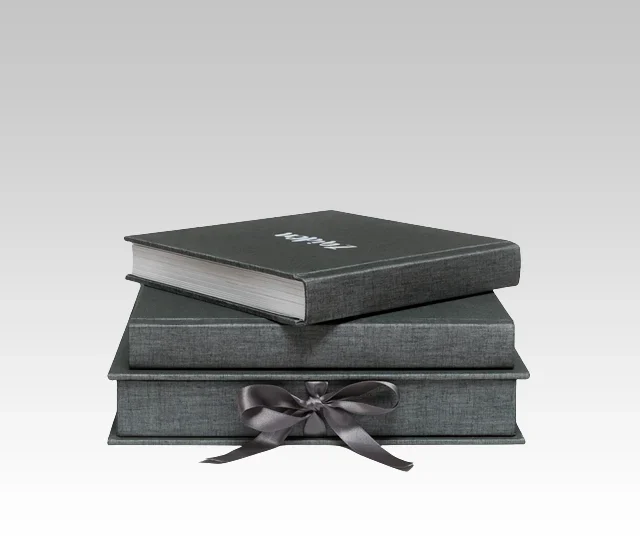
A separate lid and base is the traditional album box. The base carries the weight, the lid lifts away, and the album sits face up. It suits heavy flush-mount albums and is the simplest style to add a ribbon lift to.
A hinged lid with hidden magnets opens like a book cover and stays attached, which clients find easier to handle on a coffee table. The inside of the lid is a natural place for a printed message or a studio mark.
A clamshell has a tray fixed inside a hinged case, so the box opens flat and the album can be lifted from either side. It is the style most often chosen for large-format and archive work.
A slipcase is open on one edge and leaves the spine showing. It works well for albums stored upright on a bookshelf and for photo books sold at retail. Studios that deliver slimmer books often choose printed slipcase boxes because they add protection without much bulk.
For a heavy album, choose rigid chipboard wrapped in paper. A large wedding album with thick pages can weigh several pounds, and the base has to carry that without bowing when the box is picked up by its edges.
The wrap is what the client touches. Printed art paper takes full-color photography and exact brand colors. Linen-texture and book-cloth style papers give a tactile surface that pairs well with a debossed or foil-stamped name. Kraft suits rustic and outdoor wedding work.
Lighter photo books do not always need a rigid box. A paperboard carton or an E-flute corrugated box prints well, ships flat and costs less per piece, which matters to labs that pack hundreds of books a month.
The interior decides whether the album arrives looking cared for. Common fittings include:
Keep the fit snug. An album that slides inside its box will scuff its own corners in transit.
Custom album boxes can be printed in CMYK or PMS colors on the outside and the inside. Many studios choose a single solid color with a small foil-stamped or debossed logo, because the box should frame the album rather than compete with it. Soft-touch lamination gives a velvety surface that resists fingerprints better than gloss. Spot UV adds a subtle sheen to a monogram or pattern on a matte background.
One practical tip: brand the box for the studio, not for the individual client. Printing a couple’s names and date on each box means a new print run every time. Most photographers order one design in bulk and add the personal detail themselves with a belly band, a tag or one of their own custom labels and stickers.
No. A rigid album box is presentation packaging and should travel inside a shipping carton. Wrapped paper corners dent easily, and a parcel label on a linen lid ruins the handover. Size the outer carton an inch or so larger all around and fill the gap with paper. Studios that ship every order usually keep a stock of plain or printed corrugated mailer boxes sized to fit their album box exactly.
Record album boxes follow different rules. A standard LP jacket is a little over twelve inches square, so the box interior is set slightly larger and the depth is built around the number of records, plus any booklet, poster or print. Spine printing matters here, since box sets are shelved edge-on. Lift-off lids and slipcases are the usual structures, and rigid board is preferred because a multi-record set is heavy for its size.
Boxify Now builds printed album boxes to your measurements, with no die or plate charges and free design support if you need help turning a logo into print-ready artwork. Before production you receive a digital proof and a 3D mockup, so you can check the fit, the color and the logo position. Minimums are low, shipping is free, and your quote will confirm delivery details for your location and the timeline for your order.
To order, send the album dimensions, the box style, the quantity and your artwork as a PDF, AI or EPS file. We reply with a quote, prepare the proof for your approval and then move to production.
Buy album boxes that do justice to the work inside them. Order now, or request a quote with your album size and we will recommend a structure and finish.
Any size. Each box is made to the finished dimensions of your album, from small square photo books to large landscape wedding albums and twelve-inch record sets. Send the width, height and thickness and we will set the internal measurements with the right clearance.
Most are rigid chipboard wrapped in printed or textured paper, which suits heavy albums and long-term keeping. Lighter photo books can be packed in paperboard or E-flute corrugated boxes that ship flat. We recommend a board once we know the weight and how the box will be used.
Yes. A foam or card insert can be die-cut with a recess for a flash drive, placed beside the album or in a separate compartment. Tell us the drive dimensions, or send a sample measurement, so the well grips it without being tight.
Yes. Inside printing is available in CMYK or PMS colors, and the inner lid is a popular spot for a studio logo, a short message or a pattern. It is shown on your digital proof alongside the outside artwork before anything is produced.
Soft-touch or matte lamination suits most studio branding because it feels good in the hand and hides fingerprints. Foil stamping, embossing and debossing add a logo without heavy ink coverage. Gloss lamination and spot UV are available where you want more shine.
Minimums are low, so small studios can order without filling a storeroom. The exact quantity options depend on the structure and materials you choose, and they are shown on your quote together with pricing for larger runs if you want to compare.
Timing depends on the box style, the finishes and the quantity. Rigid boxes with foil or custom inserts take longer than simple folding cartons. Your timeline is confirmed on your quote, so share any wedding-season deadline when you get in touch.
Yes, shipping is free. Your quote will confirm delivery details for your location. If you need boxes sent to a studio and a lab, or to more than one address, mention it when you request the quote so the delivery plan is clear.
Yes. You receive a digital proof and a 3D mockup showing the artwork, logo position and box structure. Nothing goes into production until you approve it, and changes at proof stage are part of the free design support.
Send artwork as a PDF, AI or EPS file at 300 DPI in CMYK. Vector logos give the cleanest foil and deboss results. If you only have a low-resolution logo, our design team can help prepare it for print at no charge.
Printing a different name on every box means a separate run each time, so most studios order one branded design and add client names with a sticker, tag or belly band. It keeps unit cost down and lets you personalize boxes on your own schedule.
Paperboard and corrugated album boxes ship flat and fold up when needed. Traditional rigid boxes arrive assembled, because the board is glued and wrapped into shape. If storage space is limited, ask about a collapsible rigid structure when you request your quote.
Yes. A divided base or a two-level insert keeps prints flat in their own section so they do not press against the album cover. Give us the print sizes and the approximate stack height and we will plan the compartments around them.
Yes. Record album boxes are sized around the LP jacket and the number of records, with room for booklets or posters. Lift-off lid and slipcase styles are common, and the spine can be printed so the set reads clearly on a shelf.
Paper-based packaging is widely recyclable, though local rules vary. Boxes with magnets, ribbon or foam inserts may need those parts removed first. If recyclability matters to your clients, ask us about card inserts and paper wraps without lamination.