
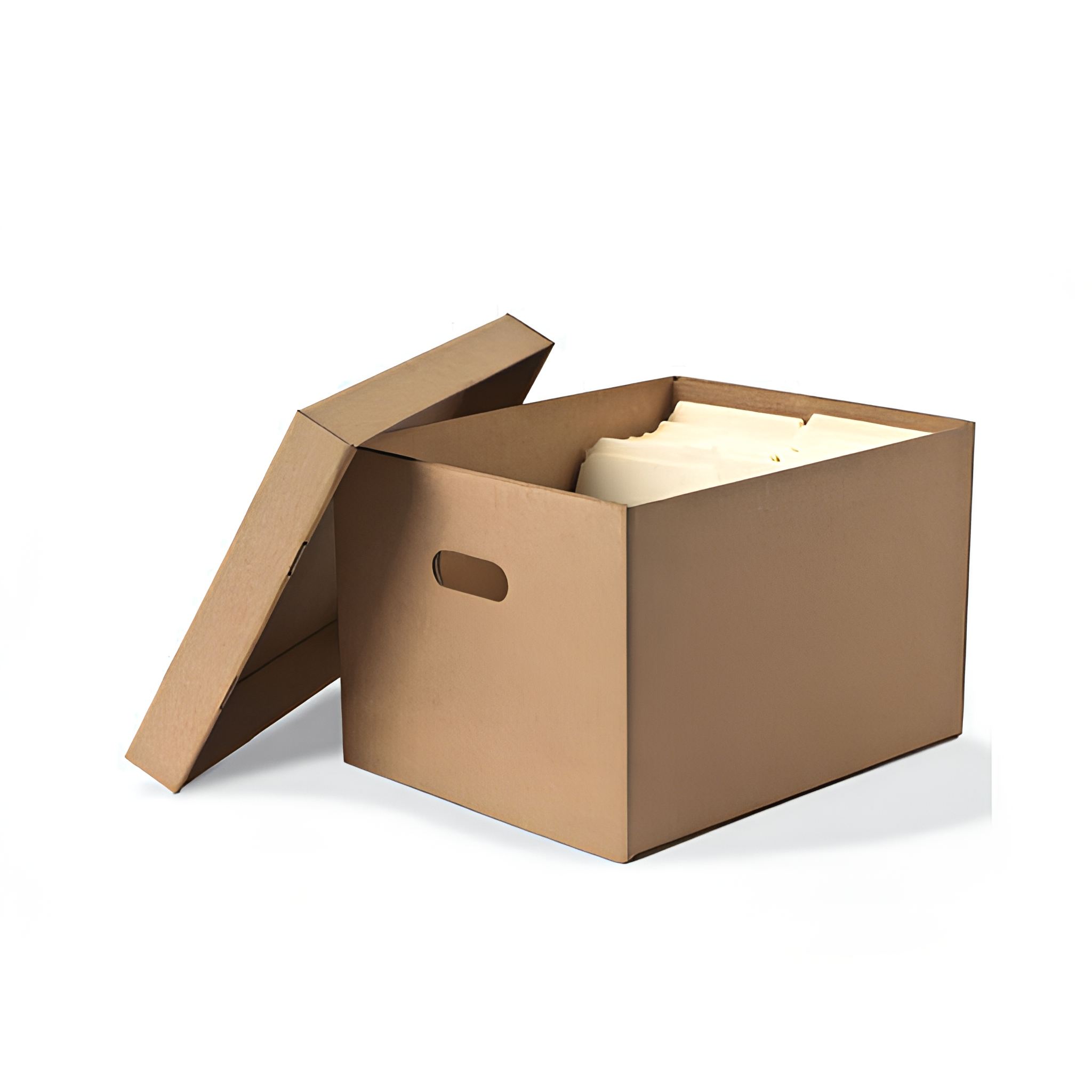
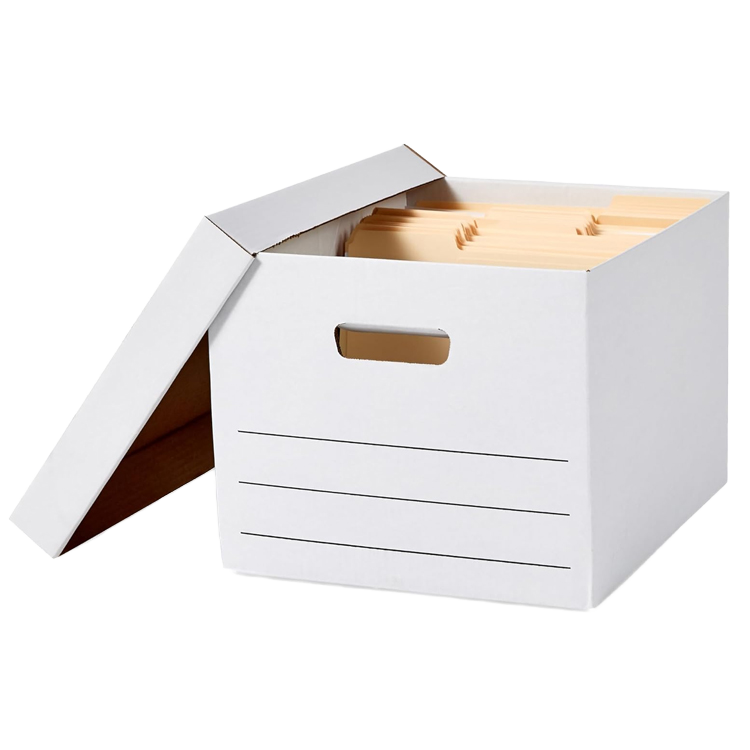
Archive boxes are corrugated storage cartons with lids and hand holes, sized for letter and legal files, binders and business records. Law firms, accounting practices, medical offices and records management companies buy archive boxes to keep paperwork organized, stackable and easy to retrieve. Custom printed archive boxes can carry an index panel for contents, date ranges and destruction dates, so every carton is identified at a glance. Order archive boxes with your logo for client-facing storage, or ask about wholesale archive boxes for a full records room. Buy now or request a quote.
Archive boxes are corrugated cardboard cartons made to store paper records, files and binders for months or years. Most have a lift-off or attached lid, hand holes for carrying and enough stacking strength to sit on shelving or on top of one another. Offices use them to move inactive files out of filing cabinets while keeping them labeled and retrievable.
Any organization that has to keep paper for a set period uses archive boxes. Law firms store closed matters, accountants keep client tax files, medical and dental practices hold patient charts, and schools, banks and government offices all work to retention schedules. Records management and self-storage companies order printed archive boxes in volume and supply them to their own customers, often with a barcode area and their branding on every panel. Moving companies carry them too, since an office relocation usually starts with the file room, and they sit naturally alongside custom moving boxes on the same order.
The right size depends on what goes inside, so start with the document and work outward.
The familiar banker-style carton, roughly 15 inches long, 12 inches wide and 10 inches high, takes letter-size folders across the 12-inch side and legal-size folders along the 15-inch side. It is the safest choice for mixed records and fits most records-center shelving.
Ring binders are taller and wider than hanging folders. Measure the tallest binder with its spine upright, add a small allowance for fingers, and size the box so binders stand in a single row without leaning.
Checks, index cards, X-ray films, drawings and ledgers each need their own dimensions. Send the size and the quantity per box, and we will build the carton around them. A full box should be something one person can lift, so for dense paper it is better to choose a smaller carton than to overfill a large one.
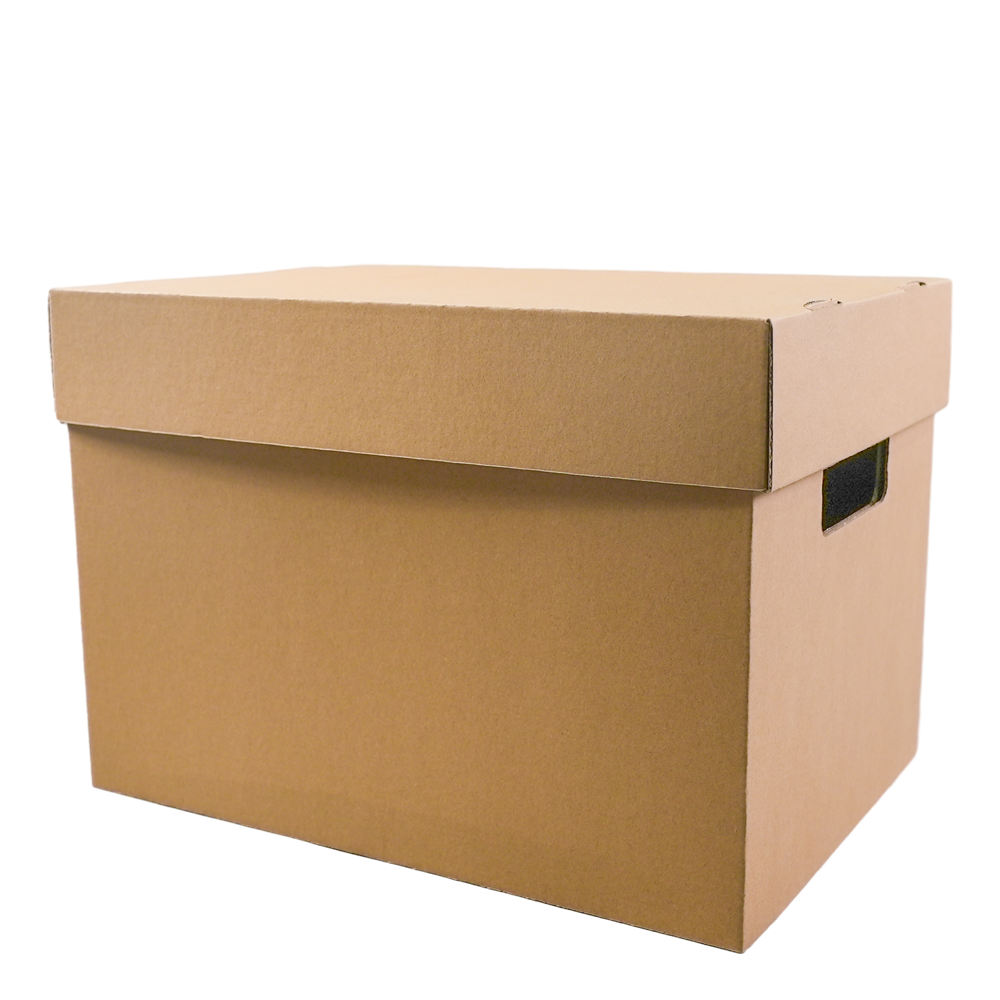
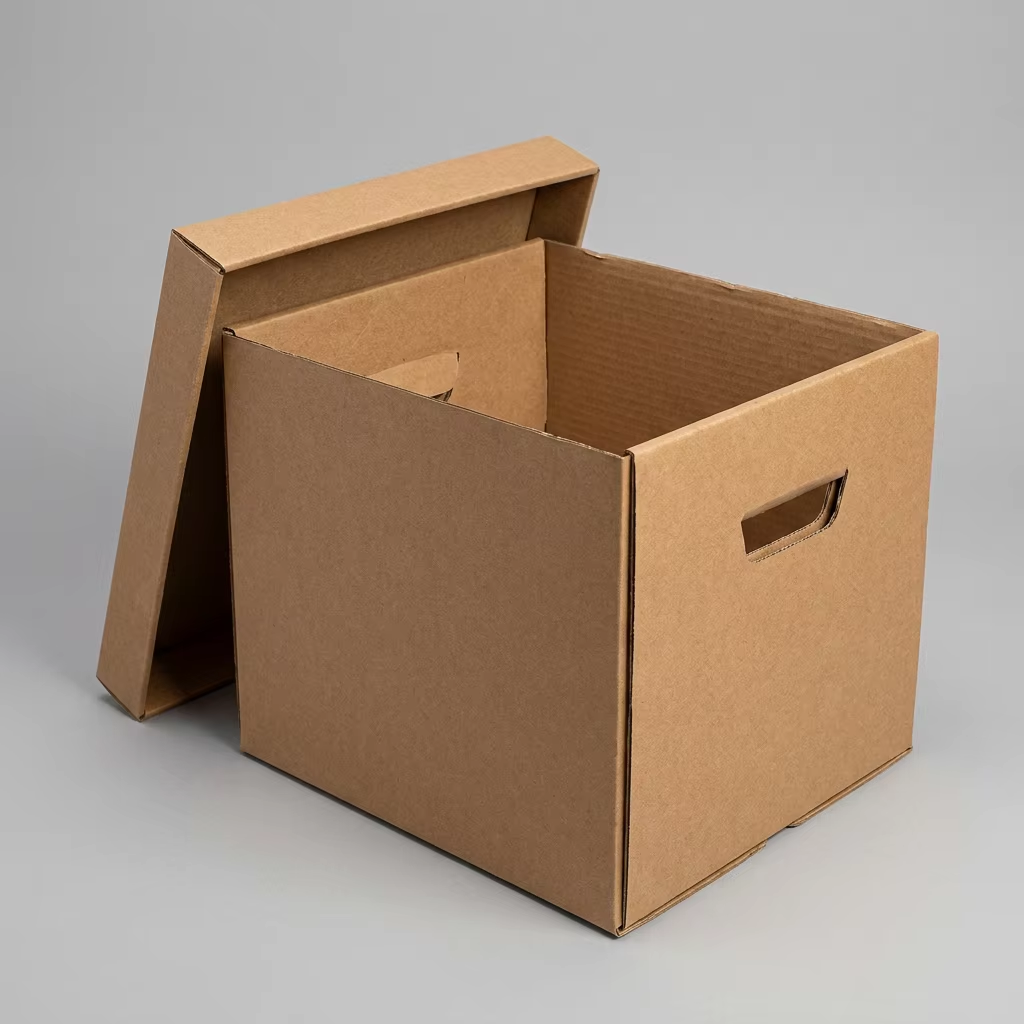
A lift-off lid works best for boxes that are opened often, while an attached lid suits long-term storage because it cannot be separated from its box. Lift-off lids let staff reach files quickly, flip-top lids hinge along the back, and tie closures add security in transit. If you need a general-purpose lidded carton for products instead of paperwork, our cardboard boxes with lids follow the same idea.
Hand holes should be cut into double-thickness end panels, because that is where the carton takes the strain when a full box is carried. If your storage area is dusty, ask for hand holes with a fold-in flap that closes the opening while the box is on the shelf.
Strong enough to carry a stack of full boxes without the bottom carton bowing. A box of paper is heavy, and records rooms stack cartons several high. Single-wall corrugated with doubled end panels handles everyday office storage on shelves. Double-wall board, or a design with double-layer ends and a double bottom, is the better choice for floor stacking, warehouse racking and frequent handling.
Think about how the boxes will be handled as well as how they will sit. Cartons that travel between an office and an off-site records center are lifted, slid and restacked many times, and corners take most of that wear. A double-layer end panel protects the corners and stops the hand holes tearing out. If boxes will be stored for years and opened rarely, stacking strength matters more than handling strength, and a snug lid that keeps dust and light out earns its place.
Kraft board hides scuffs and is the economical workhorse. White board gives a cleaner look for client-facing storage and makes printed text and handwritten notes easier to read.
Print whatever helps someone find the right box in seconds. The most useful feature is an index panel on one or both ends with ruled fields to fill in by hand. Common fields include:
Beyond the index panel, many firms add a logo, a confidentiality notice and stacking arrows. Records companies often leave a blank area sized for their barcode. If you would rather apply variable details afterward, custom labels and stickers can be printed to match the box.
A few habits keep archived records in good condition:
Boxify Now makes archive boxes to your dimensions, board grade and print layout, with free design support to set up the index panel and logo. There are no die or plate charges, minimums are low, and you receive a digital proof and 3D mockup before production. Boxes ship flat to save storage space, and shipping is free, with delivery details confirmed on your quote.
Tell us the internal size or the documents you need to store, the quantity, your preferred lid style and whether you want kraft or white board. Send artwork as a PDF, AI or EPS file at 300 DPI in CMYK, or ask our designers to build it. We confirm price and timeline on your quote, and production starts once you approve the proof.
Whether you need a few cartons for year-end files or branded archive box packaging for a records center, buy online or request a quote and we will size the box to your records.
Archive boxes store inactive paper records such as client files, invoices, patient charts and personnel folders. They free up filing cabinets, keep documents grouped and labeled, and stack neatly on shelving until the records are needed again or reach the end of their retention period.
The most common size is about 15 x 12 x 10 inches. Letter-size folders fit across the shorter side and legal-size folders along the longer side, so one carton handles both. We also make custom sizes for binders, ledgers and other formats.
Yes, in the standard banker-style size. Turn letter folders to face the 12-inch width and legal folders to face the 15-inch length. If you store only one format, a dedicated size wastes less space, and we can build that for you.
They are made from corrugated cardboard, usually single-wall for shelf storage and double-wall for floor stacking or heavy handling. You can choose natural kraft or white outer liners. End panels are often doubled to strengthen the hand holes and corners.
It depends on board grade, box size and the weight inside, so tell us how you plan to store them. Shelved boxes carry little load, while floor stacks need double-wall board or reinforced ends. Keep stacks low enough for safe lifting.
Yes. You can choose a separate lift-off lid, an attached flip-top lid or a tie closure. Lift-off lids are convenient for boxes opened regularly, and attached lids suit long-term storage because the lid always stays with its box.
Most styles fold and lock together by hand without tape or glue. The panels tuck into each other to form double-thickness ends and a firm base. Boxes ship flat, and assembly takes a few moments once you have done the first one.
Yes. We can print an index panel with ruled fields for department, contents, date range, box number and destruction date on one or both ends. Staff fill it in with a marker, so every carton is identified from the aisle.
Yes. Logos, contact details and confidentiality notices can be printed in CMYK or PMS colors on any panel, including the lid. Records storage and moving companies often brand all four sides so the box is recognizable however it is shelved.
Corrugated archive boxes are widely used for multi-year business record retention in dry, indoor conditions. If you are preserving photographs or historic papers for decades, mention it when you request a quote so we can discuss board and liner options for that purpose.
Yes. Custom corrugated dividers can split a carton into sections for smaller folders, checks, media or index cards. Tell us what each compartment needs to hold and we will include the divider layout in your proof.
Minimums are low, which suits small offices preparing for year-end filing as well as records centers ordering by the pallet. Share the quantity you have in mind and we will quote for it, along with larger wholesale tiers if you want to compare.
Timing depends on quantity, board and print coverage, and it is confirmed on your quote. Production starts after you approve the digital proof. If you have an office move or audit date coming, let us know when you first get in touch.
Send PDF, AI or EPS files at 300 DPI in CMYK. If you only have a logo and a rough idea of the index fields you want, our free design support will lay out the panels and send a proof for your approval.
Paper-based packaging such as corrugated board is widely recyclable, though local rules vary. Remember that the documents inside may need secure shredding first. Flatten empty cartons before recycling, and remove any non-paper labels or ties if your local program asks for it.


