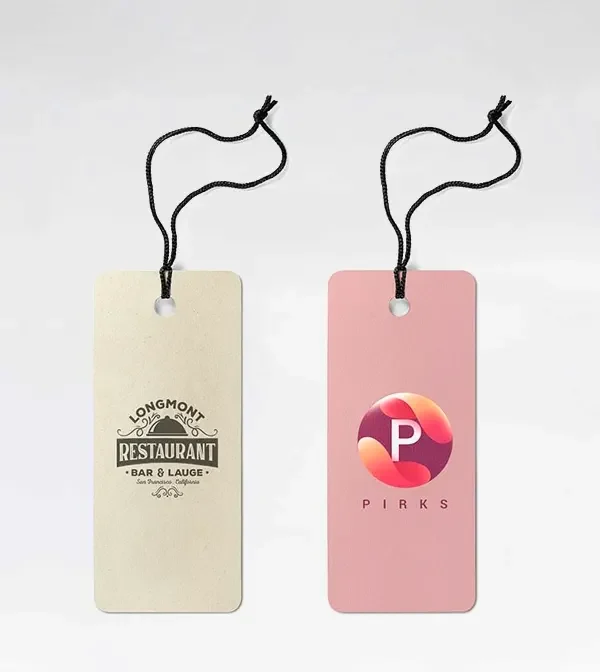
A hang tag is often the only printed piece a shopper reads before deciding, so it has to carry brand, price and details in a few square inches. Our tags printing service makes hang tags, swing tags and folded tags for apparel, jewelry, gifts and bottles. Choose custom printed tags in any shape, on coated, uncoated or kraft card, drilled and strung to order. Makers buy tags in short runs, and clothing labels order tags wholesale by the season. Free design support puts a tag with your logo on proof before printing. Buy now or request a quote.
Tags printing is the production of hang tags, swing tags and product tags: small printed cards attached to merchandise with string, ribbon or a fastener. Brands and retailers use them to show a logo, price, size, barcode and product details on items that have no box or label area of their own, such as clothing, jewelry, bags, bottles and gifts. A tag is punched with a hole and tied or pinned on, so the customer can remove it after purchase.
A hang tag should answer the questions a shopper asks while holding the product. The front is for the brand: a logo, perhaps a short tagline, and little else. The back does the practical work.
A printed tag supports, and does not replace, any permanent label that regulations require on a product, such as sewn-in fiber and care labels on clothing. Check the labeling rules that apply to what you sell.
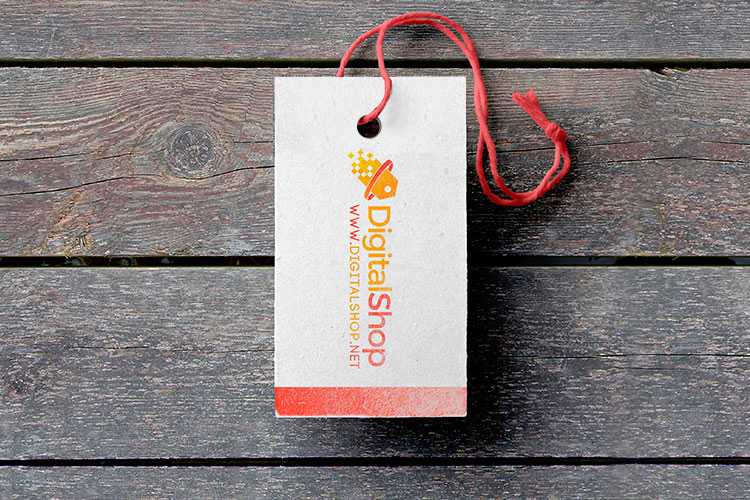
Clothing tags are usually a rectangle of heavy card, strung through a buttonhole, belt loop or neck label. Many labels use a two-part set, with a main brand tag and a smaller tag behind it for size and price, so only the small one changes between styles.
Jewelry needs small, light tags that do not overwhelm the piece, often a narrow rectangle or a folded tag that wraps a chain. Brands that present pieces in custom jewelry boxes match the tag stock and foil color to the box.
A tag with a larger hole or a slit slips over the neck of a wine, sauce, oil or candle jar. It adds tasting notes, a recipe or a gift message without redesigning the label.
Wedding favors, gift baskets and holiday items carry tags with a “to and from” area or a thank-you note, usually on uncoated stock so they can be written on.
Furniture, plants, luggage and homeware carry larger tags with dimensions, materials or care advice. Plant tags and outdoor goods benefit from lamination to resist damp.
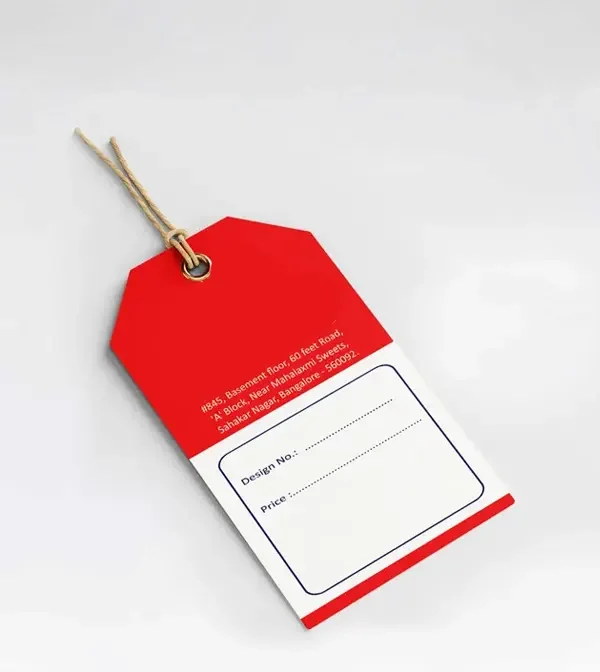
Tags can be cut to almost any outline, but a few shapes cover most orders. The standard rectangle is around 2 x 3.5 inches, the same footprint as a business card, with smaller versions near 1.5 x 3 inches for accessories. Other popular outlines are squares, circles, ovals, rounded-corner rectangles and the classic luggage shape with two clipped corners at the top.
Folded tags double the print area and open like a small booklet, which is useful for care guides and brand stories. Fully custom die-cut shapes, such as a leaf, a bottle or a logo outline, help a product stand apart on a crowded rail. When choosing a size, hold a paper cutout against the product: the tag should be easy to read without hiding what it is attached to.
Tags are attached through a drilled hole, and the hole and the stringing should be chosen together. A small hole, around an eighth of an inch, suits fine string and tag fasteners. A slightly larger one takes ribbon, twine or cord. Keep the hole clear of the edge so the card does not tear, and keep text and logos away from it.
Common attachment options:
A metal eyelet around the hole strengthens it and adds a finished detail on premium tags. Tags can be supplied drilled only, or with string already looped through, which saves hours of handwork.
Choose a stock heavy enough that the tag hangs flat and does not curl on the rail. Thick cover stock is the norm, and layered or extra-thick boards give luxury labels a tag with real weight.
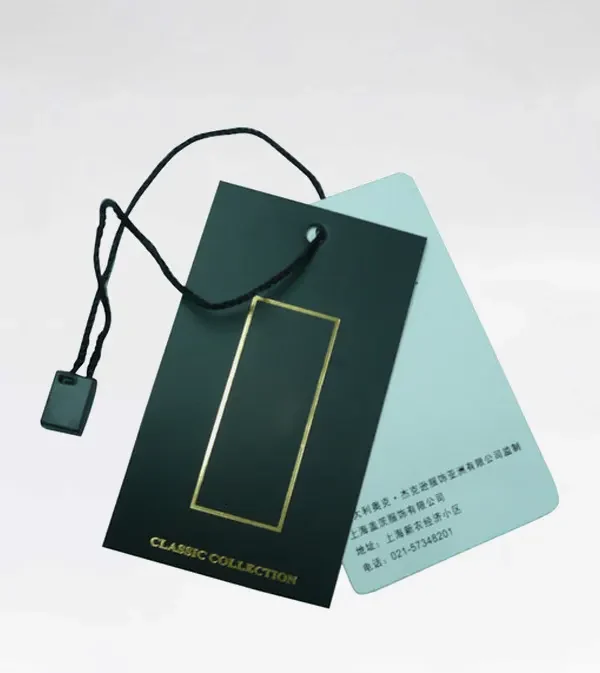
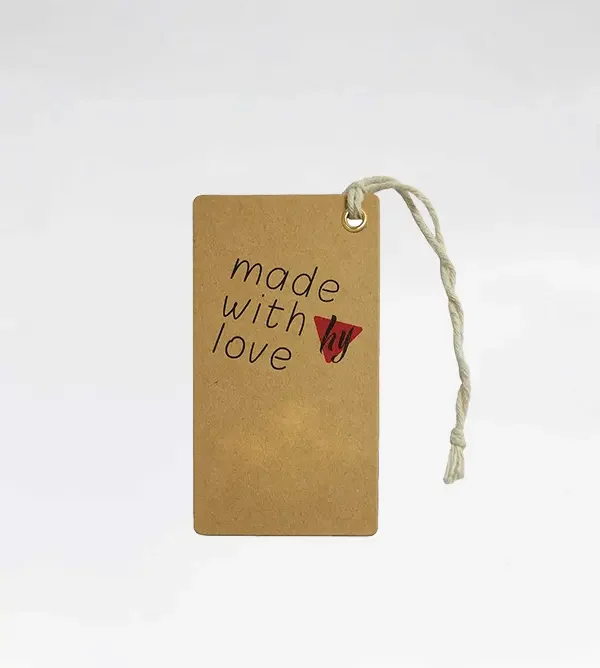
Coated card prints sharp photographs and bright solids. Uncoated card has a soft, natural surface and accepts pen and stamp ink. Kraft card suits handmade, organic and outdoor brands, and looks best with one or two dark ink colors. Textured stocks such as linen or cotton-feel papers add character to simple designs, and black card with foil printing is a favorite for evening wear and spirits.
Tags are printed on one or both sides in CMYK or in PMS spot colors where a brand color must match exactly. Because a tag is handled at close range, finishing shows. Matte or soft-touch lamination gives a smooth, refined feel. Gloss lamination and spot UV add shine. Foil stamping, embossing and debossing turn a logo into the main feature, and they work especially well on thick uncoated or textured stock.
Consistency across the purchase matters. When the tag on the garment, the tissue around it and the custom printed bags at the register share one color and finish, the brand feels deliberate.
Print barcodes in black on a white or very light area, with clear space on both sides, and never across a fold or under a gloss spot. If prices or sizes change often, leave a blank panel on the back and apply the variable details with small custom labels and stickers. One master tag then serves a whole collection, and a price change does not mean a reprint. Leave the price area uncoated or matte so stickers hold and pen ink dries.
Boxify Now offers custom tags printing in any size and shape, with the full range of stocks and finishes above. Free design support is included, from checking a finished file to laying out a front and back from your logo and product details. You see a digital proof showing the cut outline and hole position before production. Minimums are low, which suits small makers and seasonal collections, and shipping is free. Your quote will confirm delivery details for your location.
Send these and we reply with a quote that confirms price and timeline, followed by your proof. Good tags printing makes a product look finished before the customer has even tried it on. Tell us what you sell, and buy now or request a quote.
A common size is about 2 x 3.5 inches, similar to a business card, with smaller tags near 1.5 x 3 inches used for jewelry and accessories. There is no fixed standard, so tags can be cut to whatever size suits the product.
Use heavy cover stock so the tag hangs flat and resists bending. Coated card suits full-color designs, uncoated card suits writable and natural-looking tags, and kraft suits handmade brands. Extra-thick and textured boards are available for premium collections.
Yes. Most brands print the logo on the front and product details, price area and barcode on the back. Both sides can be in full color or PMS, and each side can have a different finish if needed.
Yes. Tags are drilled with a hole in the position and size you choose, typically centered near the top or in a corner. Tell us what string, ribbon or fastener you plan to use so the hole is sized to fit.
Yes. Tags can be supplied drilled only, or pre-strung with cotton string, twine, ribbon or elastic loops in a color you choose. Pre-stringing removes a slow manual job from your packing table, which matters most on larger runs.
An eyelet, or grommet, is a small metal ring set into the hole. It stops the card from tearing where the string pulls and gives the tag a finished, durable look. Eyelets suit thicker tags on heavier garments and bags.
Yes. Besides rectangles, circles and rounded corners, tags can be die cut to a custom outline such as a logo, leaf, bottle or garment shape. Simple, sturdy shapes work best, since thin points and narrow necks can bend or tear.
Choices include matte, gloss and soft-touch lamination, aqueous coating, spot UV, foil stamping, embossing and debossing. If staff need to write or stick a price on the tag, leave that area uncoated or choose a matte surface.
Supply the barcode as vector artwork in solid black on a white or light background, at the size your retailer or system specifies, with clear margins either side. Avoid placing it near the hole, an edge, a fold or a glossy finish.
Yes. Give us the number of designs and the quantity of each. This is common for collections with different product names or colors. Each design appears on your proof, and keeping size, stock and finish the same simplifies production.
Yes. A folded tag is scored down the middle and opens like a small card, giving four printable faces. It is useful for care instructions, a brand story or multilingual text. The hole is drilled through both layers near the fold.
We accept PDF, AI and EPS files at 300 DPI in CMYK, with 0.125 inch bleed and fonts outlined. Mark the hole position if you have a preference. If you have only a logo, our design team can build the layout.
Yes. A digital proof shows the front, the back, the cut outline and the hole position at actual proportions. Check spelling, prices, barcodes and care wording, then approve the proof or ask for changes. Production starts after approval.
Minimums are low, so small makers and new labels can order a practical quantity. The starting number depends on size, stock, finishing and stringing, and your quote will state it clearly before you decide.
The timeline is confirmed on your quote and depends on quantity, finishing and whether the tags are strung. Production begins when the proof is approved. Shipping is free, and your quote will confirm delivery details for your location.