


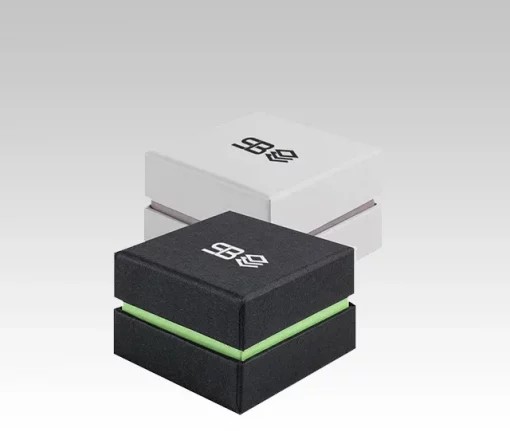

A shoulder box is a rigid box with an inner neck that the lid slides over, so lid and base meet in a clean line or leave a deliberate band of contrast color. Fragrance houses, watchmakers, candle brands and spirits labels buy shoulder boxes when the packaging has to feel as considered as the product. Boxify Now builds custom printed shoulder boxes to your dimensions, with fitted inserts, foil stamping and embossing. We supply wholesale shoulder boxes with low minimums and free design support. Order shoulder boxes with your logo. Buy now or request a quote.
Shoulder boxes are rigid setup boxes made from three parts: a base, a lid and an inner neck that is fixed inside the base and rises above its rim. The lid slides down over the neck and rests on the edge of the base, which is the “shoulder” that gives the style its name. They are used for premium products where a precise fit and a slow, controlled opening are part of the presentation.
It is built as a box within a box. Where a standard rigid box has two parts, a shoulder box has three, and the third is what changes how it looks and feels.
Because lid and base share the same outer dimensions, the closed box has straight, uninterrupted sides. That is the visible difference from two-piece rigid setup boxes, where the lid is wider than the base and overlaps it.
The style is defined by how much of the neck you can see when the box is closed, and there are three common answers.
The lid comes all the way down to meet the base. The neck is hidden until the box is opened, and the join shows only as a fine line. This is the most understated version and suits minimal branding.
The lid stops short of the base and leaves a band of the neck on show. Wrapping the neck in a contrast color or a metallic paper turns that band into a design feature. A narrow reveal looks refined, while a wider band makes a bolder statement.
The join does not have to sit in the middle. A shallow lid on a deep base suits tall products such as bottles and candles. A deep lid on a shallow base presents the product on a low plinth once the lid is lifted, which works well for watches and jewelry.
They are used wherever the box is expected to be kept or where the opening is part of what the customer pays for. Typical products include fragrance and cologne, watches, fine jewelry, luxury candles, spirits and wine accessories, skincare sets, premium chocolates, pens, headphones and small electronics, and corporate or commemorative gifts.
Watch brands are among the most frequent buyers, and many custom watch boxes use a shoulder structure with a cushion or cuff insert. The neck adds wall thickness around the product, so the style also gives fragile items a little more protection than a single-wall rigid box.
Because the lid fits the neck closely, air has to escape as it rises, so the lid of a well-made shoulder box glides off slowly instead of simply lifting away. Customers notice that resistance. It suggests care and precision before the product is even visible.
The fit is a design choice. A tight tolerance gives a slow, weighted lift, while a slightly looser one opens more easily and suits products bought for older customers or opened frequently. A thumb notch or ribbon tab can be added if the lid needs help. If you want a hinged lid that snaps shut instead, magnetic closure rigid boxes are the closer match.
The structure is rigid chipboard, a dense gray board that does not fold or flex. Thicker board gives heavier walls and a more substantial feel, while thinner board keeps weight and shipping volume down.
The chipboard is covered with a wrap, and the wrap is where the look comes from:
Base, neck and lid can each take a different wrap. A common approach is a single color for lid and base with the neck in a contrast shade, so the color appears only at the reveal and when the box is opened.
The right insert depends on weight, fragility and how the product should be lifted out. It sits inside the neck and keeps the product fixed and centered.
Start with the product, not the outside of the box. Measure the length, width and height of the item, or of the item sitting in its insert, and give us those figures as the internal dimensions.
Three points are specific to this style. First, the usable space is the inside of the neck, which is smaller than the outside of the base by the thickness of two walls on each side. Second, decide how tall the neck should stand, because it sets how far the lid travels and how much product shows when the lid is off. Third, tell us the reveal you want, even if that is zero. We will work out the board allowances and show the result on a mockup.
Wraps are printed in CMYK or PMS before they are applied, and the inside of the lid and neck can be printed too. PMS inks are worth specifying when the lid, base and neck must match or contrast exactly.
Shoulder boxes tend to look best with restrained decoration: a foil-stamped logo on the lid, a debossed mark on the base, or spot UV over a matte or soft-touch surface. Embossing gives a logo depth without adding color. Gloss lamination is available where a brighter, more reflective finish suits the brand.
Send us your product dimensions, the shoulder style and reveal, insert requirements, quantity and artwork as a PDF, AI or EPS file at 300 DPI in CMYK. Free design support is available if you need a dieline or help choosing wraps, and there are no die or plate charges.
Your quote confirms the timeline and delivery details for your location, and shipping is free. You then receive a digital proof and a 3D mockup to approve before production. Note that shoulder boxes are rigid, so they arrive assembled and ready to fill instead of flat. Plan storage space accordingly. Low minimums make short runs for launches and limited editions practical.
If your product deserves a box people keep, shoulder boxes are one of the most convincing ways to deliver it. Buy now or request a quote and tell us what you are packing.
It is a rigid box with a base, a lid and an inner neck fixed inside the base. The lid slides over the neck and rests on the rim of the base, giving the closed box straight sides and a precise fit.
In a two-piece box, the lid is larger than the base and overlaps it. In a shoulder box, lid and base are the same outer size and meet edge to edge, guided by the inner neck. The result looks cleaner and opens more slowly.
The reveal is the band of neck left visible between lid and base when the box is closed. A flush shoulder has no reveal. A partial reveal shows a strip that is often wrapped in a contrast color or metallic paper as a design accent.
Yes. The base, neck and lid are wrapped separately, so each can use a different paper or printed color. A contrast neck is the most popular option because the color appears at the reveal and again when the lid is lifted.
Fragrance, watches, jewelry, candles, spirits, skincare sets, chocolates, pens and small electronics are all common. The style fits any product where presentation and protection matter and the customer is likely to keep the box afterward.
The lid fits closely around the neck, so air must escape as it rises. That creates gentle resistance and a smooth, slow opening. The tightness can be adjusted in the design if you prefer a lid that comes away more easily.
The structure is rigid chipboard, covered in a wrap such as printed art paper, textured specialty paper, kraft, or linen-effect and leatherette-effect paper. Inserts are made from foam, paperboard or card dividers depending on the product.
Choose foam with a die-cut cavity for glass, watches and electronics that need a firm hold. Paperboard fitments suit lighter items and keep the pack paper-based. Dividers work for sets. Send us the product and we will suggest the best option.
Measure the length, width and height of your product, including any insert, and send those as internal dimensions. Also tell us how tall the neck should be and how much reveal you want. We calculate the board allowances and show them on your mockup.
Yes. The inside of the lid, the neck and the base can be printed in CMYK or PMS, or wrapped in a colored or textured paper. Inside-lid printing is often used for a logo, brand statement or product information.
Foil stamping, embossing, debossing and spot UV are the most popular, usually over a matte or soft-touch surface. Gloss lamination is also available. Textured wraps are normally left unlaminated so the feel of the paper comes through.
No. Rigid shoulder boxes are assembled during manufacturing and arrive ready to fill, usually with the lid on. They take more storage space than folding cartons, so it helps to plan where the delivery will be kept before it arrives.
We keep minimums low so shoulder boxes are practical for product launches, limited editions and small luxury brands. The starting quantity depends on size, wrap and insert, and it will be set out on your quote.
Rigid boxes involve more handwork than folding cartons, and timing varies with quantity, wraps and inserts. We confirm the timeline on your quote. If you are working to a launch date, tell us at the start.
Send artwork as a PDF, AI or EPS file at 300 DPI in CMYK, with PMS references where needed. We return a digital proof and a 3D mockup showing the lid, neck, base and reveal. Production begins once you approve them.


