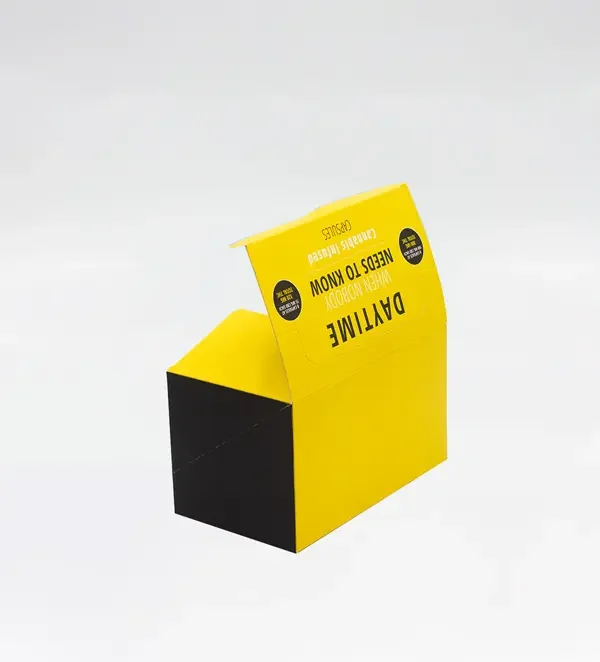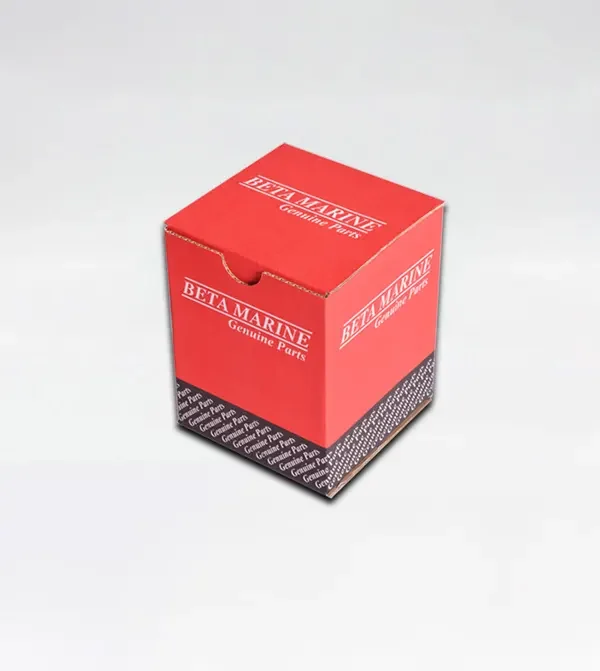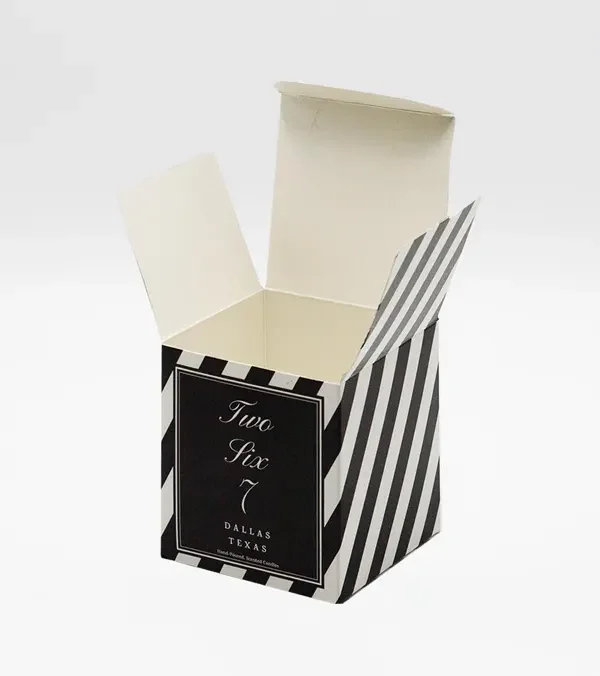
Folding boxes are paperboard cartons that arrive flat, pop open in seconds and carry everything from cosmetics and supplements to snacks, candles and small electronics. Brands that buy folding boxes from Boxify Now choose the exact size, board weight and closure style their product needs. Our custom printed folding boxes are produced in CMYK or PMS color with matte, gloss, soft-touch, foil or spot UV finishes. Retailers and co-packers order folding boxes wholesale for long production runs, and startups can get folding boxes with logo artwork at low minimums. Buy now or request a quote.
Folding boxes are cartons cut and creased from a single sheet of paperboard, glued along one seam and shipped flat until they are needed. Opened and filled by hand or on a cartoning machine, they are the standard retail package for cosmetics, food, supplements, candles, toys and many other light to medium-weight products.
Folding boxes are used as primary retail packaging for products that need a printed, shelf-ready carton without the weight or cost of a rigid box. Walk through any drugstore and most of what sits on the shelf is a folding carton: toothpaste, face cream, vitamins, tea, cereal bars, phone cables.
They suit any business that packs in volume, since a case of flat cartons takes little storage room and each one erects in a couple of seconds. Typical buyers include:
The structure you choose decides how the box is filled, how it closes and how much weight the bottom can carry.
Tuck end styles close with a flap that tucks into the box at the top and bottom. On a straight tuck both flaps fold from the same panel, which leaves a clean front face; on a reverse tuck they fold from opposite panels and nest efficiently on the press sheet. Both are covered on our tuck boxes page, and they are the default for light items such as lip balm, serum bottles and small accessories.
When the product is heavier, the base needs more than a friction tuck. A snap lock bottom has four flaps that interlock by hand. An auto-lock bottom is pre-glued, so the base sets itself as the carton is squared up, which is why busy packing tables prefer auto-lock boxes for candles, glass jars and bottles.
Open-ended sleeves slide over a tray, a tub or another box and add branding with very little board. Gable tops, hang tab cartons, five-panel hangers and window cartons all start from the same folding carton principle with extra panels or die cuts added.
Most folding boxes are made from paperboard between 14 pt and 24 pt thick, and the right choice depends on product weight and the look you want.
As a rule, a light item such as a 1 oz dropper bottle does well in 14 pt or 16 pt board, while a heavy candle or a tall carton that must not bow is better in 18 pt to 24 pt.
Measure the product itself, not an old box, and give the dimensions as length by width by depth, in that order. Length and width describe the opening you look into; depth is the distance from the opening to the base. Quote internal dimensions, since board thickness and score lines take up space on the outside.
Allow a little clearance, roughly a sixteenth to an eighth of an inch per side, so the product slides in without scuffing but does not rattle. If a bottle has a pump or dropper cap, measure to its tallest and widest points. For multi-item sets, send a dimensioned sketch and we will suggest an insert layout.
A folding carton gives you every panel to work with, including the inside. Boxify Now prints in CMYK for photographic artwork and in PMS spot colors when a brand shade has to match from run to run. Inside printing is popular for a pattern, a thank-you message or directions for use.
Finishing protects the ink and sets the tone. Gloss lamination makes color pop; matte reads calm and modern; soft-touch adds a velvety feel that suits skincare and fragrance. Aqueous coating is an economical protective layer. Spot UV, foil stamping, embossing and debossing pick out a logo or pattern. Keep foil and embossing away from score lines, where the board bends.
Yes. Folding boxes are glued at the side seam and then collapsed, so thousands fit in a few cases. That saves freight and warehouse space compared with rigid boxes, which arrive assembled. Store the cases flat, off the floor and away from damp. Let cartons come up to room temperature before running them on a machine, since cold, dry board is more likely to crack at the scores.
A few details separate a carton that packs smoothly from one that slows the line down.
Boxify Now builds custom folding boxes to your dimensions, with no die or plate charges. Free design support is included, so if you have a logo and a rough idea, our team can lay the artwork onto the dieline for you. Before anything is printed you receive a digital proof and a 3D mockup to check panel order, copy and color breaks. Low minimums make a first run realistic for a new product, and shipping is free; your quote will confirm delivery details for your location.
Send us the product dimensions and weight, the style you have in mind, the quantity and any finishes you want. We reply with a quote that confirms the timeline. Once you approve it, we send the dieline or place your artwork for you; files are accepted as PDF, AI or EPS at 300 DPI in CMYK. You sign off the proof and mockup, and production begins.
Whether you need a simple reverse tuck carton or printed folding boxes with foil, a window and a fitted insert, tell us about the product and request a quote today.
A folding box is made from thin paperboard, glued at one seam and shipped flat for you to erect. A rigid box is built from thick chipboard wrapped in paper and arrives assembled. Folding cartons cost less to ship and store; rigid boxes feel heavier and more premium.
Light products such as lip balm or small tubes sit well in 14 pt or 16 pt board. Heavier items, tall cartons and anything in glass usually need 18 pt to 24 pt. Tell us the product weight and we will recommend a caliper.
Yes. We print CMYK or PMS color on the inside as well as the outside. Brands use the interior for patterns, instructions, a brand story or a short message that customers see when they open the flap.
On a straight tuck carton both closing flaps fold from the same panel, so the front shows no raw edge. On a reverse tuck carton the top and bottom flaps fold from opposite panels. Reverse tuck is economical; straight tuck gives a cleaner display face.
No. They arrive glued at the side seam and folded flat, packed in cases. You square each carton up, close the bottom, insert the product and tuck the top. Auto-lock bottoms set themselves as the box opens, which speeds hand packing.
Yes. A die-cut window can be left open or covered with clear PET window film so customers see the product without handling it. Send us the shape and position you want and we will add it to the dieline and proof.
Paperboard inserts are the usual choice: a folded platform, a collar with a die-cut hole or dividers for sets. They hold bottles and jars centered and stop movement in transit. Inserts can be printed or left plain white or kraft.
We offer low minimums, so a new product or a seasonal run does not require a huge commitment. Tell us the quantity you have in mind when you request a quote and we will confirm what is possible for your style and size.
Timing depends on the quantity, the finishes and how quickly the proof is approved. Your timeline is confirmed on your quote before you commit, so you can plan a launch date around a clear schedule.
Yes, shipping is free. Your quote will confirm delivery details for your location. Because folding boxes ship flat, even large orders pack into a compact number of cases that are easy to receive and store.
Every order gets a digital proof and a 3D mockup before production. Check spelling, panel order, barcode placement and color callouts carefully, since the approved proof is what we print. Changes are easy to make at this stage.
Send PDF, AI or EPS files at 300 DPI in CMYK, with fonts outlined and bleed included. If you do not have print-ready art, our free design support can place your logo and copy onto the dieline.
Many styles can, including tuck end and glued-end cartons. Let us know the machine type and any supplier specifications, such as flap direction and board grain, when you request a quote so the dieline suits your equipment.
Paper-based packaging is widely recyclable, and folding cartons are generally accepted with paper and cardboard. Local rules vary, particularly for cartons with window film or heavy lamination, so check with your local program.
For a precise brand color we print with PMS spot inks, which are mixed to a reference instead of being built from four process colors. Give us the PMS number with your artwork and it will be called out on your proof.